These free Year 3 maths worksheets cover the main objectives for the first year of Key Stage 2 in England (age 7 to 8). Each sheet is generated at random, so you can print a fresh version for practice, homework or a quick check, and each one has an answer page.
Year 3 extends place value to 1,000, introduces formal column addition and subtraction with three-digit numbers, adds the 3, 4 and 8 times tables, starts written multiplication of a two-digit number by a one-digit number, works with tenths and fractions of amounts, and asks children to tell the time on clocks with Roman numerals.
Age 7 to 8 · Key Stage 2 (lower) · National curriculum in England
Try a Year 3 worksheet: Column addition of 3-digit numbers
The sheet below is made fresh each time you load the page. Press Randomize for new questions, or Edit Worksheet to change the numbers.
Place value to 1,000
Hundreds, tens and ones, then adding and subtracting 100s mentally.
- Draw a three-digit number on an abacus
- Make all the 3-digit numbers from 3 digit cards
- Adding multiples of 100 (e.g. 500 + 200)
- Subtracting multiples of 100
- Adding 100 to any number below 1,500
- Subtracting 100 from any number below 1,500
Column addition and subtraction
Formal written methods with three-digit numbers. Start with the 'no carrying' sheets.
- Column addition of 3-digit numbers (no carrying)
- Column addition of 3-digit numbers
- Column subtraction of 3-digit numbers (no regrouping)
- Column subtraction of 3-digit numbers
Multiplication and division: 3, 4 and 8
The new Year 3 times tables, their division facts and the first written multiplication.
- Multiplying by 3
- Multiplying by 4
- Multiplying by 8
- Dividing by 3 (no remainders)
- Dividing by 4 (no remainders)
- Dividing by 8 (no remainders)
- Multiplying two-digit numbers by 10
- Short multiplication: 2-digit by 1-digit
Fractions
Tenths and fractions of amounts, then adding fractions that share a denominator.
- Tenths of numbers to 100
- Halves, thirds, quarters and fifths of numbers to 50
- Adding fractions with the same denominator
Time and temperature
Roman numerals I to XII on clock faces, and reading scales in steps of 2 and 10.
- Draw the hands on a Roman numeral clock
- Write the time shown on a Roman numeral clock
- Read a thermometer: 0 to 50 °C
Sample sheet and answer key
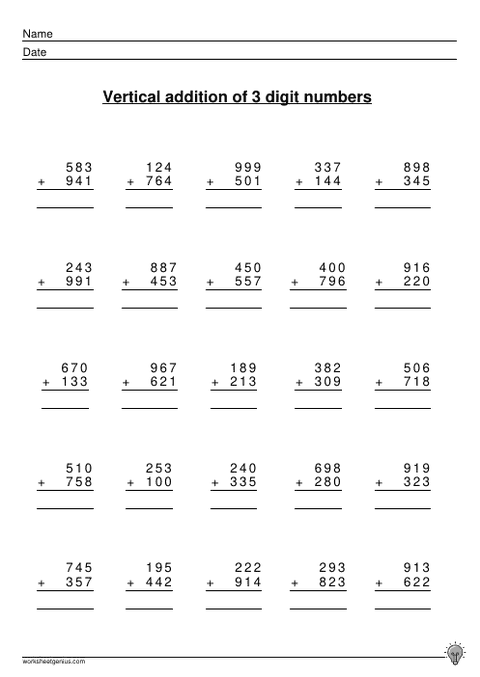
This is one printed version of the column addition of 3-digit numbers worksheet. The PDF has the questions on page 1 and the answers on page 2.
Download the sample PDF with answers
For a different set of questions, use the Randomize button above or open any worksheet in the lists on this page.
More Year 3 maths topics
- 3 times table
- 4 times table
- 8 times table
- Column addition and subtraction
- Place value cards
- Adding fractions
Frequently asked questions
What maths do children learn in Year 3?
In England, Year 3 maths covers numbers to 1,000, column addition and subtraction with three-digit numbers, the 3, 4 and 8 times tables, multiplying a two-digit number by a one-digit number, tenths, fractions of amounts, adding and subtracting fractions with the same denominator, perimeter, and telling the time including Roman numerals I to XII.
Which times tables are taught in Year 3?
Year 3 adds the 3, 4 and 8 times tables to the 2, 5 and 10 learned in Year 2. All tables up to 12 x 12 follow in Year 4.
How do I print a worksheet?
Use the Print Worksheet button under the preview rather than the browser's print button, or press Download Worksheet to save a PDF.